
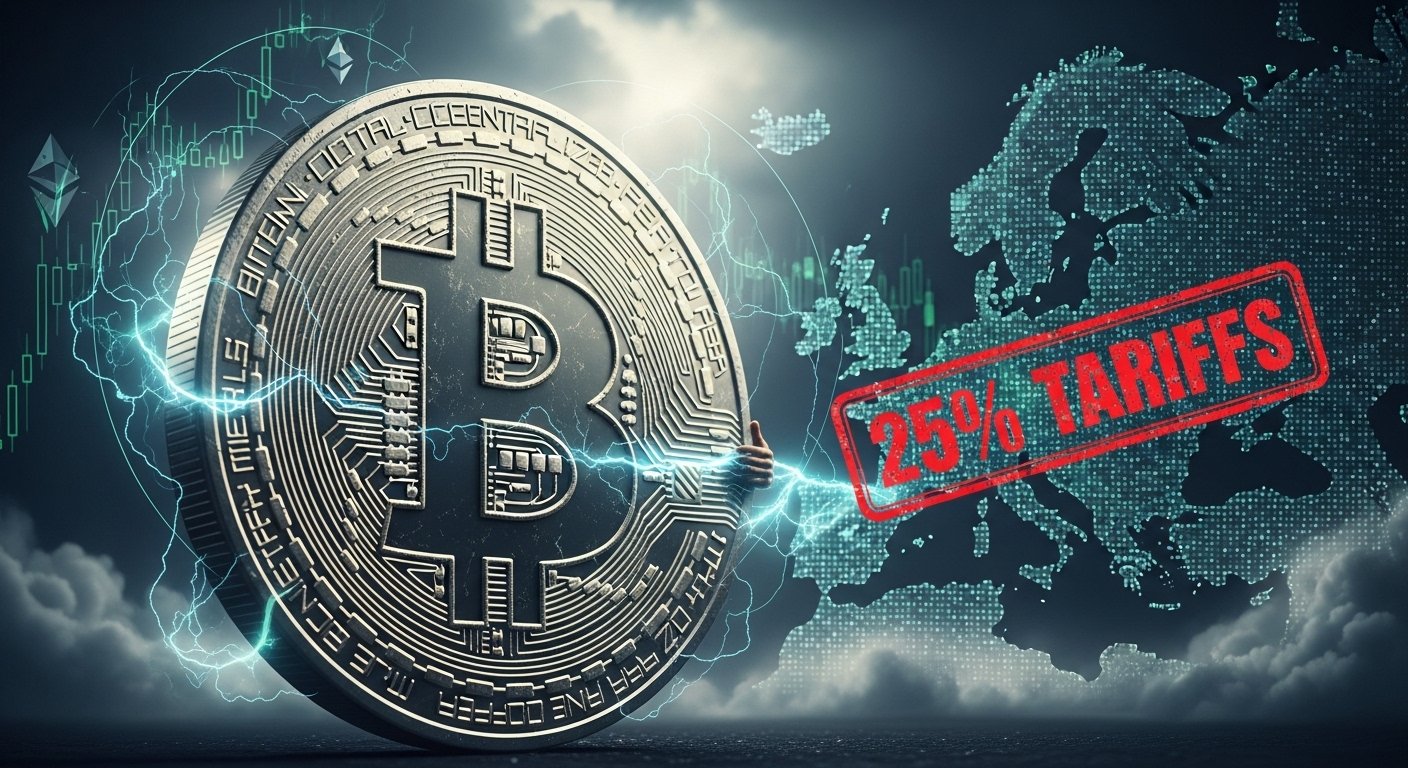
A Sudden Shock in Global Markets
The global financial landscape took an unexpected turn after reports emerged that former U.S. President Donald Trump imposed a 25% tariff on European goods, linked to escalating tensions over Greenland. While the political reasoning remains controversial, the impact was immediately felt across markets, especially in risk-sensitive assets like cryptocurrencies. Investors quickly shifted into a cautious mode as uncertainty spread across both traditional and digital financial sectors.
Bitcoin, often seen as a hedge during macro uncertainty, initially showed mixed reactions. Some traders expected a rally due to fear in traditional markets, while others anticipated a short-term dip as investors moved to cash and stable assets. The result was a volatile trading environment, with sharp price swings reflecting uncertainty rather than a clear directional trend.
Bitcoin Reacts to Rising Geopolitical Pressure
As news of the tariffs circulated, Bitcoin experienced increased volatility, with rapid fluctuations in both buying and selling pressure. Traders reacted to the broader risk-off sentiment, which often leads to short-term corrections in crypto markets even when long-term outlooks remain strong. This behavior highlights how interconnected digital assets have become with global political developments.
At the same time, some long-term investors viewed the dip as an opportunity. Historically, Bitcoin has shown resilience during geopolitical stress, often recovering after initial panic-driven movements. However, in the short term, liquidity tightened as market participants waited for clearer signals from both political leaders and economic indicators.
Geopolitics Meets Digital Assets
The situation also highlights how geopolitical decisions can now influence decentralized financial systems. Even though Bitcoin operates independently of governments, investor sentiment remains deeply tied to global stability. Events like tariffs, trade disputes, and territorial tensions can indirectly shape crypto price movements through risk perception.
This growing connection between politics and digital assets suggests that Bitcoin is no longer isolated from traditional macroeconomic forces. Instead, it behaves increasingly like a global risk asset, reacting to uncertainty in ways similar to equities and commodities.
What Comes Next for Bitcoin
Looking ahead, market direction will likely depend on how the tariff situation evolves and whether tensions between the U.S. and Europe escalate further. If uncertainty continues, Bitcoin may remain volatile as traders react to headlines rather than fundamentals.
On the other hand, if diplomatic progress stabilizes markets, Bitcoin could regain momentum driven by long-term adoption trends and institutional interest. For now, caution dominates sentiment, and traders are closely watching every development.
FAQs
Why did Bitcoin react to the tariff news?
Because investors often treat Bitcoin as a risk-sensitive asset, reacting to global uncertainty and market fear.
Does Bitcoin depend on political events?
Not directly, but investor sentiment and liquidity are influenced by global political and economic stability.
Can Bitcoin rise during geopolitical tension?
Yes, sometimes it rises as a hedge, but short-term volatility is very common.
Is this a long-term issue for crypto?
Not necessarily. Most geopolitical shocks create temporary volatility rather than long-term damage.
What should investors watch next?
Developments in U.S.-Europe relations, market sentiment, and overall risk appetite in global markets.